Who Was Dione S Baby Zueus and Demeters Children
| Demeter | |
|---|---|
| Goddess of the harvest, agriculture, fertility and sacred law | |
| Fellow member of the Twelve Olympians | |
 A marble statue of Demeter, National Roman Museum | |
| Other names | Sito, Thesmophoros |
| Abode | Mount Olympus |
| Symbol | Cornucopia, wheat, torch, bread |
| Festivals | Thesmophoria, Eleusinian Mysteries |
| Personal information | |
| Parents | Cronus and Rhea |
| Siblings | Hestia, Hera, Hades, Poseidon, Zeus, Chiron |
| Children | Persephone, Despoina, Arion, Plutus, Philomelus, Iacchus, Hecate (Orphic) |
| Equivalents | |
| Roman equivalent | Ceres |
| Egyptian equivalent | Isis |
In ancient Greek organized religion and mythology, Demeter (; Attic: Δημήτηρ Dēmḗtēr [dɛːmɛ́ːtɛːr]; Doric: Δαμάτηρ Dāmā́tēr) is the Olympian goddess of the harvest and agriculture, presiding over grains and the fertility of the earth. She is too called Deo ( Δηώ ).[1]
Her cult titles include Sito ( Σιτώ ), "she of the Grain",[2] as the giver of food or grain,[three] and Thesmophoros ( θεσμός , thesmos: divine order, unwritten law; φόρος , phoros: bringer, bearer), "giver of customs" or "legislator", in association with the secret female-but festival called the Thesmophoria.[4]
Though Demeter is often described simply equally the goddess of the harvest, she presided also over the sacred law, and the wheel of life and death. She and her daughter Persephone were the central figures of the Eleusinian Mysteries, a religious tradition that predated the Olympian pantheon, and which may have its roots in the Mycenaean catamenia c. 1400–1200 BC.[5] I of the virtually notable Homeric Hymns, the Homeric Hymn to Demeter, tells the story of Persephone's abduction by Hades and Demeter's search for her.
Demeter was oftentimes considered to be the same figure as the Anatolian goddess Cybele, and she was identified with the Roman goddess Ceres.
Etymology [edit]
It is possible that Demeter appears in Linear A equally da-ma-te on three documents (AR Zf 1 and 2, and KY Za 2), all iii apparently dedicated in religious situations and all iii bearing merely the name (i-da-ma-te on AR Zf i and two).[6] It is unlikely that Demeter appears as da-ma-te in a Linear B (Mycenean Greek) inscription (PY En 609); the word 𐀅𐀔𐀳 , da-ma-te, probably refers to "households".[7] [viii] On the other hand, 𐀯𐀵𐀡𐀴𐀛𐀊 , si-to-po-ti-ni-ja, "Potnia of the Grain", is regarded as referring to her Bronze Age predecessor or to one of her epithets.[nine]
Demeter'south character as mother-goddess is identified in the second element of her name meter ( μήτηρ ) derived from Proto-Indo-European (PIE) *méh₂tēr (mother).[10] In artifact, different explanations were already proffered for the showtime element of her proper noun. Information technology is possible that Da ( Δᾶ ),[11] a discussion which corresponds to Gē ( Γῆ ) in Cranium, is the Doric form of De ( Δῆ ), "earth", the former name of the chthonic earth-goddess, and that Demeter is "Mother-Earth".[12] Liddell & Scott observe this "improbable" and Beekes writes, "in that location is no indication that [da] ways "earth", although information technology has as well been assumed in the proper noun of Poseidon found in the Linear B inscription Eastward-ne-si-da-o-ne, "earth-shaker".[13] [14] [15] John Chadwick as well argues that the dā element in the name of Demeter is not so simply equated with "earth".[16]
Yard. 50. West has proposed that the give-and-take Demeter, initially Damater, could exist a borrowing from an Illyrian deity attested in the Messapic goddess Damatura, with a form dā- ("globe", from PIE *dʰǵʰ(due east)thou-) attached to -matura ("female parent"), akin to the Illyrian god Dei-paturos (dei-, "sky", fastened to -paturos, "father"). The Lesbian course Dō- may simply reverberate a different dialectal pronunciation of the not-Greek proper noun.[17]
According to a more than popular theory,[xviii] the chemical element De- might be connected with Deo, an epithet of Demeter[19] and it could derive from the Cretan word dea ( δηά ), Ionic zeia ( ζειά )—variously identified with emmer, spelt, rye, or other grains past modernistic scholars—and then that she is the Mother and the giver of food generally.[20] [21] This view is shared by British scholar Jane Ellen Harrison, who suggests that Démeter's name means Grain-Mother, instead of World-Mother.[eighteen]
Wanax (wa-na-ka) was her male companion (Greek: Πάρεδρος, Paredros) in Mycenaean cult.[22] The Arcadian cult links her to the god Poseidon, who probably substituted the male person companion of the Great Goddess; Demeter may therefore be related to a Minoan Great Goddess (Cybele).[23]
An alternative Proto-Indo-European etymology comes through Potnia and Despoina, where Des- represents a derivative of PIE *dem (house, dome), and Demeter is "mother of the house" (from PIE *dems-méh₂tēr).[24] R. S. P. Beekes rejects a Greek interpretation, but not necessarily an Indo-European one.[14]
Iconography [edit]
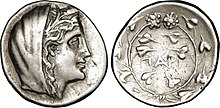
Demeter was frequently associated with images of the harvest, including flowers, fruit, and grain. She was also sometimes pictured with her daughter Persephone. Demeter is not generally portrayed with whatsoever of her consorts; the exception is Iasion, the youth of Crete who lay with her in a thrice-ploughed field, and was killed afterward by a jealous Zeus with a thunderbolt.
Demeter is assigned the zodiac constellation Virgo the Virgin by Marcus Manilius in his 1st century Roman work Astronomicon. In fine art, constellation Virgo holds Spica, a sheaf of wheat in her mitt and sits beside constellation Leo the Panthera leo.[25]
In Arcadia, she was known every bit "Black Demeter". She was said to have taken the course of a mare to escape the pursuit of her younger brother, Poseidon, and having been raped by him despite her disguise, dressed all in black and retreated into a cave to mourn and to purify herself. She was consequently depicted with the head of a horse in this region.[26]
A sculpture of the Black Demeter was fabricated by Onatas.[27]
Clarification [edit]
Every bit goddess of agronomics [edit]

Demeter, enthroned and extending her hand in a benediction toward the kneeling Metaneira, who offers the triune wheat (c. 340 BC )
In epic poetry and Hesiod's Theogony, Demeter is the Corn-Female parent, the goddess of cereals who provides grain for bread and blesses its harvesters. This was her main office at Eleusis, and became panhellenic. In Republic of cyprus, "grain-harvesting" was damatrizein.
The main theme in the Eleusinian Mysteries was the reunion of Persephone with her mother Demeter, when new crops were reunited with the erstwhile seed, a form of eternity.
Co-ordinate to the Athenian rhetorician Isocrates, Demeter's greatest gifts to humankind were agriculture, particularly of cereals, and the Mysteries which give the initiate higher hopes in this life and the afterlife.[28]
These 2 gifts were intimately connected in Demeter's myths and mystery cults. In Hesiod, prayers to Zeus-Chthonios (chthonic Zeus) and Demeter help the crops grow total and strong.[29] Demeter'due south emblem is the poppy, a bright red flower that grows amidst the barley.[30]
Demeter was besides zeidoros arοura, the Homeric "Female parent Earth arοura" who gave the gift of cereals (zeai or deai).[31]
As an globe and underworld goddess [edit]
In add-on to her role as an agronomical goddess, Demeter was frequently worshipped more generally as a goddess of the world. In Arcadia, she was represented as snake-haired, holding a pigeon and dolphin, perchance to symbolize her power over the underworld, the air, and the water.
In the cult of Flya, she was worshiped equally Anesidora, i who sends up gifts from the underworld. There was a temple of Demeter under this proper name in Phlya in Attica.[32] [33] [34]
In Sparta, she was known as Demeter-Chthonia (chthonic Demeter).[35] The Athenians chosen the dead "Demetrioi",[36] and this may reverberate a link between Demeter and ancient cult of the expressionless, linked to the agrarian-belief that a new life would sprout from the dead body, as a new found arises from buried seed.
This was probably a belief shared by initiates in Demeter's mysteries, as interpreted past Pindar: "Happy is he who has seen what exists under the earth, because he knows not just the finish of life, but also his beginning that the Gods will give".[ citation needed ]
In the mysteries of Pheneos in Arcadia, Demeter was known every bit Cidaria.[37] Her priest would put on the mask of Demeter, which was kept in a clandestine identify. The cult may take been connected with both the underworld and a form of agrarian magic.[38]
Equally a poppy goddess [edit]
Theocritus described one of Demeter'southward earlier roles every bit that of a goddess of poppies:
- For the Greeks, Demeter was still a poppy goddess
- Begetting sheaves and poppies in both hands. — Idyll vii.157
Karl Kerényi asserted that poppies were connected with a Cretan cult which was eventually carried to the Eleusinian Mysteries in Classical Hellenic republic. In a clay statuette from Gazi,[39] the Minoan poppy goddess wears the seed capsules, sources of nourishment and narcosis, in her diadem. According to Kerényi, "Information technology seems probable that the Dandy Mother Goddess who bore the names Rhea and Demeter, brought the poppy with her from her Cretan cult to Eleusis and it is almost sure that in the Cretan cult sphere opium was prepared from poppies."[40]
Robert Graves speculated that the meaning of the depiction and use of poppies in the Greco-Roman myths is the symbolism of the bright cherry-red color as signifying the promise of resurrection after death.[41]
Other functions and titles [edit]

Demeter's epithets show her many religious functions. She was the "Corn-Female parent" who blesses the harvesters. Some cults interpreted her as "Female parent-World". Demeter may be linked to goddess-cults of Minoan Crete, and embody aspects of a pre-Hellenic Mother Goddess.[42]
The most mutual epithets of Demeter are:
Achaea, Ἀχαία (" probably from achaine: loaf ,or achos: grief").[43] [44] She was worshipped at Athens by the Gephyraeans who had emigrated from Boeotia.[45] [46]
Aganippe, Ἀγανίππη ("the Mare who destroys mercifully", "Night-Mare").
Anesidora, Ἀνησιδώρα ("sender-up of gifts") at Phlya in Attica.[47]
Cabeiraea, Καβειραία΄ ("Related with the Cabeiri")[48] at Thebes.
Chloe, Χλόη, ("Light-green"),[49] that invokes her powers of ever-returning fertility, as does Chthonia.
Chthonia, Χθονία, ("under or below the globe") in Laconia.[50]
Despoina, Δέσποινα ("mistress of the house"), a Greek give-and-take similar to the Mycenean potnia. This title was likewise applied to Persephone, Aphrodite and Hecate.
Europa, Εὐρώπη, "wide face or optics" at Livadeia of Boeotia. She was the nurse of Trophonios to whom a chthonic cult and oracle was defended.[51]
Eleusinia, Ἐλευσίνια in the Mysteries at Pheneus.[52] [53] [54]
Erinys, Ερινύς, ("Fury"),[55] with a function like with the function of the avenging Dike (Justice), goddess of moral justice based on custom rules who represents the divine retribution,[56] and the Erinyes, female aboriginal chthonic deities of vengeance and implacable agents of retribution.
Ioulo Ἰουλώ, ("related with corn-sheafs") [57]
Karpophorus, Καρποφόρος ("fruit bearing").[58]
Kidaria, Κιδαρία ("kidaris : Arcadian dance")[59] at Pheneus.[60]
Lusia, Λουσία, ("Bather").[61]
Malophorus, Μαλοφόρος, ("Apple-bearer" or "Sheep-bearer") [62] at Megara and Selinus. [63]
Melaina, Μέλαινα ("black") .[64]
Mysia, Μυσία [65] at Pellene.[66] [67]
Potnia, Πότνια, ("mistress") in the Homeric Hymn to Demeter. Hera specially, but also Artemis and Athena, are addressed every bit "potnia" likewise.
Prosymne, Προσύμνη ("to whom 1 addresses hymns") at Lerna.[68]
Thermasia, Θερμασία ("Warmth") at Hermione.[69]
Thesmia, Θεσμία ("law goddess") in the Mysteries at Pheneus.[seventy] [71] [72]
Thesmophoros, Θεσμοφόρος, ("giver of customs" or "legislator"), a title connected with the Thesmophoria, a festival of secret women-only rituals continued with matrimony customs.[4] [73]
Worship [edit]

Terracotta Demeter figurine, Sanctuary of the Underworld Divinities, Akragas, 550–500 BC
In Crete [edit]
The primeval recorded worship of a deity mayhap equivalent to Demeter is found in Linear B Mycenean Greek tablets of c. 1400–1200 BC found at Pylos. The tablets depict worship of the "ii queens and the king",[74] which may exist related to Demeter, Persephone and Poseidon.[v] An early on proper name which may refer to Demeter, si-to-po-ti-ni-ja (Sito Potnia), appears in Linear B inscriptions institute at Mycenae and Pylos.[75] In Crete, Poseidon was often given the title wa-na-ka (wanax) in Linear B inscriptions, in his office equally king of the underworld, and his title Eastward-ne-si-da-o-ne indicates his chthonic nature. In the cave of Amnisos, Enesidaon is associated with the cult of Eileithyia, the goddess of childbirth,[76] who was involved with the almanac nascence of the divine child.[77] During the Bronze Historic period, a goddess of nature dominated both in Minoan and Mycenean cults, and Wanax (wa-na-ka) was her male companion (paredros) in the Mycenean cult.[76] Elements of this early form of worship survived in the Eleusinian cult, where the post-obit words were uttered: "the mighty Potnia had built-in a strong son."[78]
On the Greek mainland [edit]
Tablets from Pylos tape sacrificial goods destined for "the Two Queens and Poseidon" ("to the 2 Queens and the Rex" :wa-na-ssoi, wa-na-ka-te). The "Two Queens" may exist related with Demeter and Persephone, or their precursors, goddesses who were no longer associated with Poseidon in later on periods.[74]
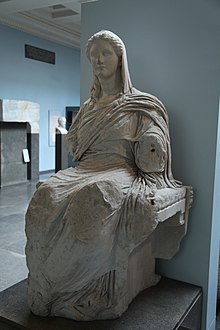
Major cults to Demeter are known at Eleusis in Attica, Hermion (in Crete), Megara, Celeae, Lerna, Aegila, Munychia, Corinth, Delos, Priene, Akragas, Iasos, Pergamon, Selinus, Tegea, Thoricus, Dion (in Macedonia)[79] Lykosoura, Mesembria, Enna (Sicily), and Samothrace.
An ancient Amphictyony, probably the primeval centred on the cult of Demeter at Anthele (Ἀνθήλη), which lay on the coast of Malis south of Thessaly. This was the locality of Thermopylae.[80] [81]
After the "First Sacred War", the Anthelan torso was known thenceforth as the Delphic Amphictyony[80]
Mysian Demeter had a seven-day festival at Pellené in Arcadia. The geographer Pausainias passed the shrine to Mysian Demeter on the route from Mycenae to Argos, and reports that co-ordinate to Argive tradition the shrine was founded past an Archive named Mysius who venerated Demeter.[82]
Festivals [edit]
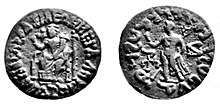
Demeter'southward two major festivals were sacred mysteries. Her Thesmophoria festival (11–13 October) was women-only.[83] Her Eleusinian mysteries were open to initiates of whatever gender or social form. At the middle of both festivals were myths concerning Demeter as Mother and Persephone equally her daughter.
Conflation with other goddesses [edit]
In the Roman period, Demeter became conflated with the Roman agricultural goddess Ceres under the Interpretatio graeca.[84] The worship of Demeter was formally merged with that of Ceres around 205 BC, along with the ritus graecia cereris, a Greek-inspired form of cult, equally part of Rome'due south general religious recruitment of deities as allies against Carthage, towards the end of the 2d Punic State of war. The cult originated in southern Italia (part of Magna Graecia) and was probably based on the Thesmophoria, a mystery cult dedicated to Demeter and Persephone as "Female parent and Maiden". It arrived forth with its Greek priestesses, who were granted Roman citizenship so that they could pray to the gods "with a foreign and external cognition, only with a domestic and civil intention".[85] The new cult was installed in the already aboriginal Temple of Ceres, Liber and Libera, Rome's Aventine patrons of the plebs; from the terminate of the 3rd century BC, Demeter'south temple at Enna, in Sicily, was acknowledged every bit Ceres' oldest, near authoritative cult center, and Libera was recognized as Proserpina, Roman equivalent to Persephone.[86] Their joint cult recalls Demeter's search for Persephone, subsequently the latter'southward abduction into the underworld by Hades (or Pluto). At the Aventine, the new cult took its place alongside the old. Information technology made no reference to Liber, whose open up and gender-mixed cult continued to play a central function in plebeian culture, as a patron and protector of plebeian rights, freedoms and values. The exclusively female initiates and priestesses of the new "greek style" mysteries of Ceres and Proserpina were expected to uphold Rome'south traditional, patrician-dominated social hierarchy and traditional morality. Unmarried girls should emulate the guiltlessness of Proserpina, the maiden; married women should seek to emulate Ceres, the devoted and fruitful Mother. Their rites were intended to secure a skilful harvest, and increase the fertility of those who partook in the mysteries.[87]
Beginning in the 5th century BCE in Asia Minor, Demeter was also considered equivalent to the Phrygian goddess Cybele.[88] Demeter'due south festival of Thesmophoria was popular throughout Asia Minor, and the myth of Persephone and Adonis in many ways mirrors the myth of Cybele and Attis.[89]
Some belatedly antique sources syncretized several "great goddess" figures into a single deity. The Platonist philosopher Apuleius, writing in the late 2nd century, identified Ceres (Demeter) with Isis, having her declare:
I, mother of the universe, mistress of all the elements, first-born of the ages, highest of the gods, queen of the shades, kickoff of those who dwell in heaven, representing in one shape all gods and goddesses. My will controls the shining heights of sky, the health-giving sea-winds, and the mournful silences of hell; the entire world worships my single godhead in a thousand shapes, with defined rites, and under many a dissimilar name. The Phrygians, first-born of mankind, call me the Pessinuntian Mother of the gods; ... the aboriginal Eleusinians Actaean Ceres; ... and the Egyptians who excel in aboriginal learning, laurels me with the worship which is truly mine and phone call me by my true name: Queen Isis.
- --Apuleius, translated by E. J. Kenny. The Aureate Donkey [90]
Mythology [edit]
Lovers and children [edit]

Some of the earliest accounts of Demeter's relationships to other deities comes from Hesiod's Theogony, written c. 700 BC. In it, Demeter is described every bit the girl of Cronus and Rhea.[91]
Demeter's nearly well-known relationship is with her daughter, Persephone, queen of the underworld. Both Hesiod and the Homeric Hymn to Demeter(2), describe Persephone equally the girl of Zeus and his older sis, Demeter,[92] though no myths exist describing her formulation or birth. The exception is a fragment of the lost Orphic theogony, which preserves part of a myth in which Zeus mates with his female parent, Rhea, in the form of a ophidian, explaining the origin of the symbol on Hermes' staff. Their daughter is said to be Persephone, whom Zeus in turn mates with to conceive Dionysus. According to the Orphic fragments, "Later becoming the female parent of Zeus, she who was formerly Rhea became Demeter."[93] [94]
Before her abduction past Hades, Persephone was known as Kore ("maiden"), and at that place is some evidence that the figures of Persephone Queen of the Underworld and Kore daughter of Demeter were originally considered dissever goddesses.[95] Withal, they must have go conflated with each other by the fourth dimension of Hesiod in the 7th century BC.[89] Demeter and Persephone were often worshiped together and were often referred to past joint cultic titles. In their cult at Eleusis, they were referred to merely equally "the goddesses", often distinguished as "the older" and "the younger"; in Rhodes and Sparta, they were worshiped as "the Demeters"; in the Thesmophoria, they were known every bit "the thesmophoroi" ("the legislators").[96] In Arcadia they were known as "the Groovy Goddesses" and "the mistresses".[ citation needed ] In Mycenaean Pylos, Demeter and Persephone were probably called the "queens" (wa-na-ssoi).[74]
Both Homer and Hesiod, writing c. 700 BC, described Demeter making beloved with the agricultural hero Iasion in a ploughed field.[97] According to Hesiod, this union resulted in the birth of Plutus.
According to Diodorus Siculus, in his Bibliotheca historica written in the 1st century BC, Demeter and Zeus were besides the parents of Dionysus. Diodorus described the myth of Dionysus' double birth (once from the globe, i.eastward. Demeter, when the constitute sprouts) and once from the vine (when the fruit sprouts from the institute). Diodorus also related a version of the myth of Dionysus' destruction by the Titans ("sons of Gaia"), who boiled him, and how Demeter gathered upwards his remains and then that he could be built-in a third fourth dimension (Diod. 3.62). Diodorus states that Dionysus' birth from Zeus and his older sis Demeter was somewhat of a minority conventionalities, possibly via conflation of Demeter with her daughter, as most sources country that the parents of Dionysus were Zeus and Persephone, and afterward Zeus and Semele.[98]
In Arcadia, a major Arcadian deity known as Despoina ("Mistress") was said to exist the girl of Demeter and Poseidon. According to Pausanias, a Thelpusian tradition said that during Demeter's search for Persephone, Poseidon pursued her. Demeter turned into a horse in order to avoid her younger brother's advances, but he turned into a stallion and mated with the goddess, resulting in the birth of the horse god Arion and a daughter "whose name they are not wont to divulge to the uninitiated".[99] Elsewhere he says that the Phigalians assert that the offspring of Poseidon and Demeter, was not a horse but in fact Despoina, "as the Arcadians call her".[100]
In Orphic literature, Demeter seems to exist the mother of the witchcraft goddess Hecate.[101]
| Offspring | Father |
|---|---|
| Persephone, Dionysus (minority belief)[102] | Zeus |
| Arion, Despoina | Poseidon |
| Corybas, [103] Plutus,[104] Philomelus[105] | Iasion |
| Eubuleus,[106] Chrysothemis[107] | Carmanor |
| Hecate | unknown |
Abduction of Persephone [edit]

Demeter'due south daughter Persephone was abducted to the underworld by Hades, who received permission from her begetter Zeus to accept her every bit his helpmate. Demeter searched for her ceaselessly, preoccupied with her grief. The seasons halted; living things ceased their growth, then began to die.[108] Faced with the extinction of all life on earth, Zeus sent his messenger Hermes to the underworld to bring Persephone dorsum. Hades agreed to release her if she had eaten nil while in his realm; only Persephone had eaten a pocket-size number of pomegranate seeds. This jump her to Hades and the underworld for sure months of every year, either the dry out Mediterranean summertime, when constitute life is threatened by drought,[109] or the fall and winter.[110] There are several variations on the basic myth; the earliest account, the Homeric Hymn to Demeter, relates that Persephone is secretly slipped a pomegranate seed by Hades[111] and in Ovid'due south version,[112] Persephone willingly and secretly eats the pomegranate seeds, thinking to deceive Hades, only is discovered and made to stay. Contrary to pop perception, Persephone's time in the underworld does not correspond with the unfruitful seasons of the ancient Greek calendar, nor her render to the upper earth with springtime.[113] Demeter's descent to retrieve Persephone from the underworld is connected to the Eleusinian Mysteries.[114]

Demeter rejoiced, for her daughter was by her side.
The myth of the capture of Persephone seems to be pre-Greek. In the Greek version, Ploutos (πλούτος, wealth) represents the wealth of the corn that was stored in underground silos or ceramic jars (pithoi). Similar subterranean pithoi were used in ancient times for funerary practices. At the beginning of the autumn, when the corn of the old crop is laid on the fields, she ascends and is reunited with her mother Demeter, for at this fourth dimension the old crop and the new meet each other.[115]
According to the personal mythology of Robert Graves,[116] Persephone is non only the younger cocky of Demeter,[117] she is in plow also i of three guises of the Triple Goddess – Kore (the youngest, the maiden, signifying green young grain), Persephone (in the center, the nymph, signifying the ripe grain waiting to exist harvested), and Hecate (the eldest of the three, the crone, the harvested grain), which to a sure extent reduces the name and role of Demeter to that of group proper name. Before her abduction, she is called Kore; and once taken she becomes Persephone ('she who brings devastation').[118]
Demeter at Eleusis [edit]


Demeter'south search for her girl Persephone took her to the palace of Celeus, the Rex of Eleusis in Attica. She causeless the form of an sometime woman, and asked him for shelter. He took her in, to nurse Demophon and Triptolemus, his sons past Metanira. To advantage his kindness, she planned to brand Demophon immortal; she secretly anointed the boy with ambrosia and laid him in the flames of the hearth, to gradually burn abroad his mortal self. But Metanira walked in, saw her son in the fire and screamed in fright. Demeter abandoned the attempt. Instead, she taught Triptolemus the secrets of agriculture, and he in plough taught them to any who wished to learn them. Thus, humanity learned how to plant, grow and harvest grain. The myth has several versions; some are linked to figures such as Eleusis, Rarus and Trochilus. The Demophon element may exist based on an earlier folk tale.[119]
Demeter and Iasion [edit]
Homer's Odyssey (c. late 8th century BC) contains maybe the earliest direct references to the myth of Demeter and her consort Iasion, a Samothracian hero whose name may refer to bindweed, a small white bloom that oftentimes grows in wheat fields. In the Odyssey, Calypso describes how Demeter, "without disguise", made honey to Iasion. "And then it was when Demeter of the braided tresses followed her heart and lay in dear with Iasion in the triple-furrowed field; Zeus was enlightened of it soon enough and hurled the bright thunderbolt and killed him."[120] However, Ovid states that Iasion lived up to old age as the married man of Demeter.[121] In aboriginal Greek culture, part of the opening of each agricultural yr involved the cutting of three furrows in the field to ensure its fertility.[122]
Hesiod expanded on the nuts of this myth. According to him, the liaison between Demeter and Iasion took identify at the wedding of Cadmus and Harmonia in Crete. Demeter, in this version, had lured Iasion abroad from the other revelers. Hesiod says that Demeter subsequently gave birth of Plutus.[123]
Demeter and Poseidon [edit]

In Arcadia, located in what is now southern Greece, the major goddess Despoina was considered the girl of Demeter and Poseidon Hippios, Equus caballus-Poseidon. In the associated myths, Poseidon represents the river spirit of the underworld, and he appears as a horse as often happens in northern European folklore. The myth describes how he pursued his older sis, Demeter, who hid from him amongst the horses of King Onkios, merely fifty-fifty in the class of a mare, she could non conceal her divinity. In the grade of a stallion, Poseidon caught and raped his older sister. Demeter was furious at Poseidon'south assault; in this furious grade, she became known as Demeter Erinys. Her anger at Poseidon drove her to dress all in blackness and retreat into a cave in club to purify herself, an act which was the crusade of a universal famine. Demeter's absence caused the death of crops, of livestock, and eventually of the people who depended on them (later Arcadian tradition held that it was both her rage at Poseidon and her loss of her daughter that caused the famine, merging the two myths).[26] Demeter washed away her anger in the River Ladon, becoming Demeter Lousia, the "bathed Demeter".[124]
"In her brotherhood with Poseidon," Kerényi noted,[125] "she was Earth, who bears plants and beasts, and could therefore assume the shape of an ear of grain or a mare." She bore a daughter Despoina ( Δέσποινα : the "Mistress"), whose proper name should not exist uttered outside the Arcadian Mysteries,[126] and a horse named Arion, with a black mane and tail.
At Phigaleia, a xoanon (wood-carved statue) of Demeter was erected in a cave which, tradition held, was the cave into which Black Demeter retreated. The statue depicted a Medusa-like figure with a horse'south head and ophidian-like pilus, belongings a dove and a dolphin, which probably represented her power over air and water:[127]
The second mountain, Mount Elaius, is some thirty stades away from Phigalia, and has a cave sacred to Demeter surnamed Black ... the Phigalians say, they concluded that this cave was sacred to Demeter and set up in it a wooden image. The image, they say, was fabricated after this mode. It was seated on a rock, like to a woman in all respects save the head. She had the head and hair of a horse, and there grew out of her head images of serpents and other beasts. Her tunic reached correct to her feet; on one of her hands was a dolphin, on the other a dove. Now why they had the image made later this fashion is plain to any intelligent man who is learned in traditions. They say that they named her Black considering the goddess had black wearing apparel. They cannot relate either who made this wooden paradigm or how it caught fire. But the former paradigm was destroyed, and the Phigalians gave the goddess no fresh image, while they neglected for the most part her festivals and sacrifices, until the barrenness fell on the land.
Demeter and Baubo [edit]

In the Orphic tradition, a mortal woman named Baubo received Demeter as her guest, and offered her meal and wine. Demeter declined them both, on business relationship of her mourning over the loss of Persephone. Baubo and so, thinking she had displeased the goddess, lifted her skirt and showed her genitalia to the goddess, simultaneously revealing Iacchus, Demeter's son. Demeter was most pleased with the sight, and delighted she accustomed the nutrient and vino.[128] [129] This tale survives in the account of Clement of Alexandria, a Christian who tried to discredit pagan practices and mythology. However several Baubo figurines (figurines of women revealing their vulvas) take been discovered, supporting the story.
Demeter and Erysichthon [edit]

Demeter orders Famine to strike Erysichthon, Elisha Whittelsey Collection
Another myth involving Demeter's rage resulting in famine is that of Erysichthon, male monarch of Thessaly.[26] The myth tells of Erysichthon ordering all of the trees in ane of Demeter'south sacred groves to be cutting down. I tree, a huge oak, was found to be covered with votive wreaths, symbols of the prayers Demeter had granted, and so Erysichthon's men refused to cut it down. The king used an axe to cut it down himself, killing a dryad nymph in the process. The nymph's dying words were a curse on Erysichthon. Demeter punished the king by calling upon Limos, the spirit of unrelenting and clamorous hunger, to enter his tummy. The more the king ate, the hungrier he became. Erysichthon sold all his possessions to buy food, but was all the same hungry. Finally, he sold his own daughter, Mestra, into slavery. Mestra was freed from slavery by her former lover, Poseidon, who gave her the gift of shape-shifting into any creature at will to escape her bonds. Erysichthon used her shape-shifting ability to sell her numerous times to make more coin to feed himself, but no amount of food was plenty. Eventually, Erysichthon ate himself.[130]
Psyche [edit]
In the tale of Eros and Psyche, Demeter forth with her sister Hera visited Aphrodite, raging with fury about the girl who had married her son. Aphrodite asked the two of them to search for her; the 2 of them attempt to talk sense into her, arguing that her son is not a niggling male child, although he might announced every bit one, and in that location'south no harm in him falling in love with Psyche. Aphrodite took offence at their words.[131]
Former afterward, Psyche in her wanderings came across an abandoned shrine of Demeter, and sorted out the neglected sickles and harvest implements she constitute there. Equally she was doing then, Demeter appeared to her, and called from distant; she warned the girl of Aphrodite's great wrath and her plan to take revenge on her. Then Psyche begged the goddess to assistance her, only Demeter answered that she could not interfere and incur Aphrodite's acrimony at her; and for that reason Psyche had to leave the shrine, or else be kept as a convict of hers.[132]
Ascalabus [edit]
While she was travelling far and wide looking for her girl, Demeter arrived exhausted in Attica. A adult female named Misme took her in and offered her a cup of h2o with pennyroyal and barley groats in it, for it was a hot day. Demeter, in her thirst, swallowed the drink awfully. Witnessing that, Misme's son Ascalabus laughed and mocked her and asked her if she would like a deep jar of that potable.[133] Demeter and then poured her drink over him and turned him into a gecko, hated by both men and gods. It was said that Demeter showed her favour to those who killed geckos.[134]
Minthe [edit]
Earlier Hades abducted her daughter, he had kept the nymph Minthe every bit his mistress. But after he married Persephone, he set Minthe aside. Minthe would often brag about being lovelier than Persephone, and saying Hades would soon come up back to her and kick Persephone out of his halls. Demeter, hearing that, grew angry and trampled Minthe; from the world and so sprang a lovely-smelling herb named later the nymph.[135] In other versions, Persephone herself is the one who kills and turns Minthe into a plant for sleeping with Hades.[136] [137] [138]
Pelops [edit]
One time Tantalus, a son of Zeus, invited the gods over for dinner. Tantalus, wanting to examination them, cutting his son Pelops, cooked him and offered him as repast to them. They all saw through Tantalus' crime except Demeter, who ate Pelops' shoulder earlier the gods brought him back to life.[139]
Other wrath myths [edit]
In the Argive version of this myth, when Demeter arrived in Argolis, a human named Colontas refused to receive her in his house, whereas his girl Chthonia disapproved of his deportment. Colontas was punished by existence burnt along with his house, while Demeter took Chthonia to Hermione, where she built a sanctuary for the goddess.[140]
Demeter pinned Ascalaphus under a stone for reporting, as sole witness, to Hades that Persephone had consumed some pomegranate seeds.[141] Later, later on Heracles rolled the stone off Ascalaphus, Demeter turned him into a short-eared owl instead.[142]
Demeter also turned the Sirens into half-bird monsters for not helping her daughter Persephone when she was abducted by Hades.[143]
Other favour myths [edit]
Demeter gave Triptolemus her ophidian-fatigued chariot and seed, and bade him scatter it across the earth (teach mankind the knowledge of agriculture). Triptolemus rode through Europe and Asia until he came to the land of Lyncus, a Scythian king. Lyncus pretended to offering what'southward accustomed of hospitality to him, only once Triptolemus fell asleep, he attacked him with a dagger, wanting to take credit of his work. Demeter so saved Triptolemus past turning Lyncus into a lynx, and ordered Triptolemus to render habitation air-borne.[144] Hyginus records a very similar myth, in which Demeter saves Triptolemus from an evil rex named Carnabon who additionally seized Triptolemus' chariot and killed one of the dragons, so he might not escape; Demeter restored the chariot to Triptolemus, substituted the dead dragon with another one, and punished Carnabon by putting him amidst the stars holding a dragon as if to kill it.[145]
During her wanderings, Demeter came upon the town of Pheneus; to the Pheneates that receives her warmly and offered her shelter she gave all sorts of pulse, except for beans, deeming it impure.[146] 2 of the Pheneates, Trisaules and Damithales, had a temple of Demeter built for her.[147] Demeter also gifted a fig tree to Phytalus, an Eleusinian human, for welcoming her in his home.[148]
When her son Philomelus invented the turn and used it to cultivate the fields, Demeter was so impressed by his good work she immortalized him in the sky by turning him into a constellation, the Boötes.[149]
Likewise giving gifts to those who were welcoming to her, Demeter was too a goddess who nursed the young; all of Plemaeus's children born by his first wife died in cradle; Demeter took compassion of him and reared herself his son Orthopolis.[150] Plemaeus built a temple to her to give thanks her.[151] Demeter as well raised Trophonius, the prophetic son of either Apollo or Erginus.[152]
Genealogy [edit]
| Demeter's family tree[153] | |||||||||||||||||||||||||||||||||||||||||||||||||||||||||||||||||||||||||||||||||||||||||||||||||||||||||||||||||||||||||||||||||||||||||||||||||||||||||||||||||||||||||||||||||||||||||||||||||||||||||||||||||||||||||||||||||||||||||||||||||||||||||||||||||||||||||||||||||||||||||||||||||||||||||||||||||||||||||||||||||||||||||||||||||||||||||||||||||||||||||||||||||||||||||||||||||||||||||||||||||||||||||||||||||||||||||||||||||||||||||||||||||||||||||||||||||||||||||||||||||||||||||||||||||||||||||||||||||||||||||||||||||||||||||||||||||||||||||||||||||||||||||||||||||||||||||||||||||||||||||||||||||||||||||||||||||||||||||||||||||||||||||||||||||||||||||||||||||||||||||||||||||||||||||||||||||||||||||||||||||||||||||||||||||||||||||||||||||||||||||||||||||||||||||||||||||||||||||||||||||||||||||||||||||||||||||||||||||||||||||||||||||||||||||||||||||||||||||||||||||||||||||||||||||||||||||||||||||||||||||||||||||||||||||||
|---|---|---|---|---|---|---|---|---|---|---|---|---|---|---|---|---|---|---|---|---|---|---|---|---|---|---|---|---|---|---|---|---|---|---|---|---|---|---|---|---|---|---|---|---|---|---|---|---|---|---|---|---|---|---|---|---|---|---|---|---|---|---|---|---|---|---|---|---|---|---|---|---|---|---|---|---|---|---|---|---|---|---|---|---|---|---|---|---|---|---|---|---|---|---|---|---|---|---|---|---|---|---|---|---|---|---|---|---|---|---|---|---|---|---|---|---|---|---|---|---|---|---|---|---|---|---|---|---|---|---|---|---|---|---|---|---|---|---|---|---|---|---|---|---|---|---|---|---|---|---|---|---|---|---|---|---|---|---|---|---|---|---|---|---|---|---|---|---|---|---|---|---|---|---|---|---|---|---|---|---|---|---|---|---|---|---|---|---|---|---|---|---|---|---|---|---|---|---|---|---|---|---|---|---|---|---|---|---|---|---|---|---|---|---|---|---|---|---|---|---|---|---|---|---|---|---|---|---|---|---|---|---|---|---|---|---|---|---|---|---|---|---|---|---|---|---|---|---|---|---|---|---|---|---|---|---|---|---|---|---|---|---|---|---|---|---|---|---|---|---|---|---|---|---|---|---|---|---|---|---|---|---|---|---|---|---|---|---|---|---|---|---|---|---|---|---|---|---|---|---|---|---|---|---|---|---|---|---|---|---|---|---|---|---|---|---|---|---|---|---|---|---|---|---|---|---|---|---|---|---|---|---|---|---|---|---|---|---|---|---|---|---|---|---|---|---|---|---|---|---|---|---|---|---|---|---|---|---|---|---|---|---|---|---|---|---|---|---|---|---|---|---|---|---|---|---|---|---|---|---|---|---|---|---|---|---|---|---|---|---|---|---|---|---|---|---|---|---|---|---|---|---|---|---|---|---|---|---|---|---|---|---|---|---|---|---|---|---|---|---|---|---|---|---|---|---|---|---|---|---|---|---|---|---|---|---|---|---|---|---|---|---|---|---|---|---|---|---|---|---|---|---|---|---|---|---|---|---|---|---|---|---|---|---|---|---|---|---|---|---|---|---|---|---|---|---|---|---|---|---|---|---|---|---|---|---|---|---|---|---|---|---|---|---|---|---|---|---|---|---|---|---|---|---|---|---|---|---|---|---|---|---|---|---|---|---|---|---|---|---|---|---|---|---|---|---|---|---|---|---|---|---|---|---|---|---|---|---|---|---|---|---|---|---|---|---|---|---|---|---|---|---|---|---|---|---|---|---|---|---|---|---|---|---|---|---|---|---|---|---|---|---|---|---|---|---|---|---|---|---|---|---|---|---|---|---|---|---|---|---|---|---|---|---|---|---|---|---|---|---|---|---|---|---|---|---|---|---|---|---|---|---|---|---|---|---|---|---|---|---|---|---|---|---|---|---|---|---|---|---|---|---|---|---|---|---|---|---|---|---|---|---|---|---|---|---|---|---|---|---|---|---|---|---|---|---|---|---|---|---|---|---|---|---|---|---|---|---|---|---|---|---|---|---|---|---|---|---|---|---|---|---|---|---|---|---|---|---|---|---|---|---|---|---|---|---|---|---|---|---|---|---|---|---|---|---|---|---|---|---|---|---|---|---|---|---|---|---|---|---|---|---|---|---|---|---|---|---|---|---|---|---|---|---|---|---|---|---|---|---|---|---|---|---|---|---|---|---|---|---|---|---|---|---|---|---|---|---|---|---|---|---|---|---|---|---|---|---|---|---|---|---|---|---|---|---|---|---|---|---|---|---|---|---|---|---|---|---|---|---|---|---|---|---|---|---|---|---|---|---|---|---|---|---|---|---|---|---|---|---|---|---|---|---|---|---|---|---|---|---|---|---|---|---|---|---|---|---|---|---|---|---|---|---|---|---|---|---|---|---|---|---|---|---|---|---|---|---|---|---|---|---|---|---|---|---|---|---|---|---|---|---|---|---|---|---|---|---|---|---|---|---|---|---|---|---|---|---|---|---|---|---|---|---|---|---|---|---|---|---|---|---|---|---|---|---|---|---|---|---|---|---|---|---|---|---|---|---|---|---|---|---|---|---|---|---|---|---|---|---|---|---|---|---|---|---|---|---|---|---|---|---|---|---|---|---|---|---|---|
| |||||||||||||||||||||||||||||||||||||||||||||||||||||||||||||||||||||||||||||||||||||||||||||||||||||||||||||||||||||||||||||||||||||||||||||||||||||||||||||||||||||||||||||||||||||||||||||||||||||||||||||||||||||||||||||||||||||||||||||||||||||||||||||||||||||||||||||||||||||||||||||||||||||||||||||||||||||||||||||||||||||||||||||||||||||||||||||||||||||||||||||||||||||||||||||||||||||||||||||||||||||||||||||||||||||||||||||||||||||||||||||||||||||||||||||||||||||||||||||||||||||||||||||||||||||||||||||||||||||||||||||||||||||||||||||||||||||||||||||||||||||||||||||||||||||||||||||||||||||||||||||||||||||||||||||||||||||||||||||||||||||||||||||||||||||||||||||||||||||||||||||||||||||||||||||||||||||||||||||||||||||||||||||||||||||||||||||||||||||||||||||||||||||||||||||||||||||||||||||||||||||||||||||||||||||||||||||||||||||||||||||||||||||||||||||||||||||||||||||||||||||||||||||||||||||||||||||||||||||||||||||||||||||||||||
Meet also [edit]
- Family tree of the Greek gods
- one Ceres, the kickoff asteroid and dwarf planet discovered, named afterward Demeter's Roman equivalent and called Demeter in Greek
- 1108 Demeter, a main chugalug asteroid 26 km in diameter, which was discovered in 1929 by Karl Wilhelm Reinmuth at Heidelberg.
- Greek mythology in popular culture
- Isis and Osiris
- Law of Demeter, a software design guideline named in honor of Demeter.
Notes [edit]
- ^ Δηώ
- ^ Σιτώ . Cf. σῖτος . Liddell, Henry George; Scott, Robert; A Greek–English Lexicon at the Perseus Projection.
- ^ Eustathius of Thessalonica, scholia on Homer, 265.
- ^ a b The Broadview Album of Social and Political Thought: Book 2: The Twentieth Century and Beyond. Broadview Press. p. 643.
- ^ a b John Chadwick, The Mycenean World. Cambridge University Press, 1976.
- ^ Y. Duhoux, "LA > B da-ma-te = Déméter? Sur la langue du linéaire A," Minos 29/30 (1994–1995): 289–294.
- ^ Y. Duhoux and A. Morpurgo-Davies, Companion to Linear B, vol. 2 (2011), p. 26. But see Ventris/Chadwick,Documents in Mycenean Greek p.242: B.Dietriech (2004):The origins of the Greek religion Bristol Phoenix Press. p.172
- ^ "da-ma-te". Deaditerranean. Minoan Linear A & Mycenaean Linear B. "PY 609 En (i)". DĀMOS: Database of Mycenaean at Oslo. University of Oslo.
- ^ Inscription MY Oi 701. "si-to-po-ti-ni-ja". Deaditerranean. Minoan Linear A & Mycenaean Linear B. "The Linear B word si-to". Palaeolexicon. Word study tool of Ancient languages. "MY 701 Oi (63)". DĀMOS: Database of Mycenaean atOslo. Academy of Oslo. Cf. σῖτος, Σιτώ .
- ^ "mother | Origin and significant of female parent by Online Etymology Dictionary". www.etymonline.com.
- ^ Δᾶ in Liddell and Scott.
- ^ "demeter | Origin and meaning of the proper noun demeter by Online Etymology Dictionary". www.etymonline.com.
- ^ Δημήτηρ . Liddell, Henry George; Scott, Robert; An Intermediate Greek–English Lexicon at the Perseus Project.
- ^ a b R. S. P. Beekes. Etymological Lexicon of Greek, Brill, 2009, p. 324.
- ^ Adams, John Paul, Mycenean divinities – List of handouts for California State Academy Classics 315. Retrieved 7 March 2011.
- ^ Chadwick, The Mycenaean World, Cambridge University Press, 1976, p. 87) "Every Greek was enlightened of the maternal functions of Demeter; if her proper name bore the slightest resemblance to the Greek word for 'mother', information technology would inevitably accept been deformed to emphasize that resemblance. [...] How did it escape transformation into *Gāmātēr, a name transparent to any Greek speaker?" Compare the Latin transformation Iuppiter and Diespiter vis-a-vis *Deus pater.
- ^ West 2007, p. 176: "The ∆α-, all the same, cannot be explained from Greek. Simply there is a Messapic Damatura or Damatira, and she need not exist dismissed as a borrowing from Greek; she matches the Illyrian Deipaturos both in the agglutination and in the transfer to the thematic declension (-os, -a). (It is noteworthy that sporadic examples of a thematically declined ∆ημήτρα are found in inscriptions.) Damater/ Demeter could therefore be a borrowing from Illyrian. An Illyrian Dā- may peradventure be derived from *Dʰǵʰ(e)g-"
- ^ a b "Harrison, Jane Ellen. Myths of Greece and Rome. 1928. pp. 63–64".
- ^ Orphic Hymn forty to Demeter (translated by Thomas Taylor: "O universal mother Deo famed, august, the source of wealth and various names".
- ^ Compare sanskr. yava, lit. yavai, Δά is probably derived from δέFα :Martin Nilsson, Geschichte der Griechischen Religion, vol. I (Verlag C.H.Beck) pp 461–462.
- ^ Harrison, Jane Ellen (5 September 1908). "Prolegomena to the study of Greek religion". Cambridge [Eng.] : The Academy press – via Cyberspace Archive.
- ^ Dietrich, p.181.
- ^ Nilsson, 1967:444
- ^ Frisk, Griechisches Etymological Woerterbuch. Entry 1271
- ^ Stott, Carole (i Baronial 2019). Planisphere and Starfinder, pp. 69. Dorling Kindersley Express. ISBN978-0-241-42169-7.
- ^ a b c Simon Hornblower, Antony Spawforth, Esther Eidinow, eds. The Oxford Companion to Classical Culture. OUP Oxford, 2014; Pausanias, viii.42.1–4.
- ^ Pausainias, viii.42.7.
- ^ Isocrates, Panegyricus 4.28: "When Demeter came to our land, in her wandering afterwards the rape of Kore, and, being moved to kindness towards our ancestors past services which may non be told save to her initiates, gave these two gifts, the greatest in the globe – the fruits of the earth, which have enabled us to rise above the life of the beasts, and the holy rite, which inspires in those who partake of information technology sweeter hopes regarding both the end of life and all eternity".
- ^ Hesiod Works and Days, 465.
- ^ Graves, Robert (1960). Greek Gods and Heroes. Dell Laurel-Leafage.
- ^ Martin Nilsson, (1967), Die Geschichte der Griechische Religion, C.F.Brook Verlag Munchen, pp 462, 466, 675–76.
- ^ Anesidora: inscribed against her figure on a white-ground kylix in the British Museum, B.Yard. 1881,0528.1, from Nola, painted by the Tarquinia painter, ca 470–460 BC (British Museum on-line catalogue entry)
- ^ Hesychius of Alexandria s.5.
- ^ Scholiast, On Theocritus ii. 12.
- ^ Pausanias three.14.5.
- ^ "Harrison, Jane Ellen. Myths of Hellenic republic and Rome. 1928. pp. 65–66".
- ^ Pausanias 8.15.3.
- ^ Martin Nilsson (1967).Die Geschichte der Griechiesche Religion Vol. I pp 477–478.
- ^ Heraklion Museum, Kerényi 1976, fig. xv.
- ^ Kerényi 1976, p. 25.
- ^ Graves, p. 96.
- ^ A Linear A inscription tin can tentatively be read equally DA-MA-TE (KY Za two), which is possibly the name of the Mother Goddess. [1]
- ^ Ἀχαία
- ^ ἁxαίνη
- ^ Herodotus, v. 61; Plutarch Isis et Osiris p. 378, d
- ^ Smith, s.five. Achaea.
- ^ Pausanias, 1.31.4.
- ^ Pausanias, 9.25.5.
- ^ Pausanias, ane.22.3.
- ^ Pausanias, 3.xiv.v.
- ^ Pausanias, 9.39.four.
- ^ Nilsson Vol. I p.577
- ^ Έλευσίνιος
- ^ "Soph.Antigone 1120".
- ^ Pausanias, 8.25.4–7.
- ^ C.M. Bowra (1957), The Greek Experience(1957:87, 169).
- ^ "ίουλος".
- ^ "καρποφόρος".
- ^ "κίδαρις".
- ^ Pausanias, 8.15.iii.
- ^ Pausanias, 8.25.6–7.
- ^ Pausanias, 1.44.3.
- ^ "μηλοφόρος".
- ^ Nilsson Vol I p.479
- ^ "μυσία".
- ^ Pausanias, 7.27.9.
- ^ Nilsson Vol I p.466
- ^ Pausanias, Guide to Greece 2.37; Plutarch, Isis and Osiris 35 (Dalby 2005, p. 135) harv error: no target: CITEREFDalby2005 (assistance)
- ^ Pausanias, two.34.6.
- ^ Nilsson Vol. I p.477
- ^ "θεσμία".
- ^ Pausanias, viii.15.4.
- ^ Stallsmith, Allaire B. (2008). "The Proper name of Demeter Thesmophoros". Greek, Roman, and Byzantine Studies. 48: 115–131.
- ^ a b c "Wa-na-ssoi, wa-na-ka-te, (to the two queens and the male monarch). Wanax is best suited to Poseidon, the special divinity of Pylos. The identity of the two divinities addressed as wanassoi, is uncertain ": George Mylonas (1966) Mycenae and the Mycenean age" p. 159 :Princeton University Printing
- ^ George Mylonas (1966), "Mycenae and the Mycenean world ". p.159. Princeton University Printing
- ^ a b Dietrich, pp. 181–185.
- ^ Dietrich, p. 141.
- ^ Dietrich, p. 167.
- ^ Cohen, A, Art in the Era of Alexander the Nifty: Paradigms of Manhood and Their Cultural Traditions, Cambridge University Press, 2010, p. 213. Googlebook preview
- ^ a b 50. H. Jeffery (1976) Archaic Greece: The Urban center States c. 700–500 BC. Ernest Benn Ltd., London & Tonbridge pp. 72, 73, 78 ISBN 0-510-03271-0
- ^ The Parian marble. Entry No v: "When Amphictyon son of Hellen became male monarch of Thermopylae brought together those living round the temple and named them Amphictyones; [2]
- ^ Pausanias, seven.27.9.
- ^ Benko, Stephen, The virgin goddess: studies in the pagan and Christian roots of mariology, BRILL, 2004, note 111 on pp. 63 – 4, and p. 175.
- ^ Larousse Desk-bound Reference Encyclopedia, The Volume People, Haydock, 1995, p. 215.
- ^ Spaeth, Barbette Stanley, The Roman goddess Ceres, University of Texas Press, 1996, pp. four, 6–xiii, citing Arnobius, who mistakes this as the first Roman cult to Ceres. His belief may reflect its high contour and ubiquity during the later Imperial period, and possibly the fading of older, distinctively Aventine forms of her cult.
- ^ Scheid, John, "Graeco Ritu: A Typically Roman Way of Honoring the Gods," Harvard Studies in Classical Philology, 97, Greece in Rome: Influence, Integration, Resistance, 1995, p.23.
- ^ Spaeth, Barbette Stanley, The Roman goddess Ceres, University of Texas Press, 1996, pp. thirteen, xv, sixty, 94–97.
- ^ Eur.Hel.1301–45 and Melanippid.764PMG.
- ^ a b Kore / Persephone. Encyclopedia of the Hellenic World: Asia Minor. http://asiaminor.ehw.gr/Forms/fLemmaBody.aspx?lemmaId=10541#noteendNote_11
- ^ Apuleius (1998). The Golden Donkey. Penguin classics.
- ^ Hesiod, Theogony 453-455; Hard, p. 67.
- ^ Hesiod, Theogony 912; Homeric Hymn to Demeter (2).
- ^ Proclus, Commentary on Plato's Cratylus 403 e (90, 28 Pasqu.) [= Orphic fr. 145 Kern]; West 1983, p. 217.
- ^ Kerényi 1976, p. 112.
- ^ Zuntz, K., Persephone. Three essays in religion and thought in Magna Graecia (Oxford 1971), p. 75-83.
- ^ Martin Nilsson (1967) Die Geschichte der Griechische Faith pp.463, 477
- ^ Homer, Odyssey v.125; Hesiod, Theogony 969–974.
- ^ Diodorus Siculus, Book 3.
- ^ Pausanias, eight.28.five–7.
- ^ Pausanias, 8.42.1.
- ^ Scholiast on Apollonius of Rhodes, Argonautica 3.467 = Pherecydes, fr. 44 Fowler = FGrHist 3 fr. 44 = Vorsokr. ii B xvi = Bacchylides, fr. 1 B Snell-Maehler = Orphic fr. 41 Kern.
- ^ Scholiast on Pindar, Pythian Odes 3.177; Hesychius
- ^ Diodorus Siculus, 5.48.ii.
- ^ Hesiod, Theogony 969—974; Morford, p. 339.
- ^ Hyginus, De Astronomica 2.4.7.
- ^ Diodorus Siculus, 5.76.3; Pausanias, 2.30.3.
- ^ Pausanias, x.seven.2, 10.xvi.5.
- ^ Kerényi 1951, pp. 232–241 and notes 784–798.
- ^ As in Burkert, Greek Faith (Harvard, 1985) p. 160.
- ^ Every bit in Porphyry
- ^ "HOMERIC HYMN TO DEMETER". www.uh.edu.
- ^ Ovid, Metamorphoses (Book V, ln. 533–571)
- ^ Graf, "Demeter" in Brill's New Pauly
- ^ "The Eleusinian Mysteries: The Rites of Demeter". Earth History Encyclopedia . Retrieved 27 Apr 2019.
- ^ Martin Nilsson, Greek Popular Religion. pp 48–50
- ^ Graves' work on Greek myth was ofttimes criticized; see The White Goddess#Criticism and The Greek Myths.
- ^ The idea that Kore (the maiden) is not Demeter's daughter, but Demeter'south own younger self, was discussed much before than Graves, in Lewis Richard Farnell (1896), The Cults of the Greek States, volume three, p.121.
- ^ Graves, pp. 94–95.
- ^ Nilsson (1940), p. 50: "The Demophon story in Eleusis is based on an older folk-tale motif which has cypher to do with the Eleusinian Cult. Information technology is introduced in order to let Demeter reveal herself in her divine shape".
- ^ Homer, Odyssey 5.125 ff (trans. Shewring)
- ^ Smith, due south.5. Iasion; Ovid, Metamorphoses 9.421
- ^ "IASION - Greek Demi-God of the Samothracian Mysteries".
- ^ Hesiod, Theogony 969—974; Gantz, p. 64; Tripp, s.v. Iasion; Oxford Classical Dictionary, s.5. Iasion.
- ^ Other ritually bathed goddesses were Argive Hera and Cybele; Aphrodite renewed her own powers bathing herself in the body of water.
- ^ Kerényi 1951, p. 185.
- ^ "In Arcadia she was besides a 2d goddess in the Mysteries of her daughter, the unnameable, who was invoked just as 'Despoina', the 'Mistress'" (Kerényi 1967, pp. 31ff., citing Pausanias, 8.37.9.
- ^ L. H. Jeffery (1976). Primitive Greece: The Greek city states c. 800-500 B.C. (Ernest Benn Limited) p 23 ISBN 0-510-03271-0
- ^ Clement of Alexandria, Exhortation to the Greeks two.11; Grimal, south.5. Baubo.
- ^ Graves, p. 92.
- ^ Ovid, Metamorphoses 8.738–878; Callimachus, Hymn VI to Demeter 34 ff..
- ^ Apuleius, The Golden Ass 5.28-31
- ^ Apuleius, The Golden Ass six.ane-4
- ^ Ovid, Metamorphoses v.446-461; Antoninus Liberalis, Metamorphoses 24; Tripp, s.5. Ascalabus.
- ^ Antoninus Liberalis, Metamorphoses 24.
- ^ Oppian, Halieutica 3.485 ff
- ^ Strabo, Geographica viii.3.14.
- ^ Scholia ad Nicandri Alexipharmaca 375
- ^ Ovid, Metamorphoses 10.728
- ^ Lycophron, Alexandra 152-155; Hyginus, Fabulae 83; Grimal, south.v. Pelops.
- ^ Pausanias, Description of Greece 2.35.4
- ^ Apollodorus, 1.5.3.
- ^ Apollodorus, 2.5.12.
- ^ Hyginus, Fabulae 141
- ^ Ovid, Metamorphoses five.642-678
- ^ Hyginus, De Astronomica 2.14.2.
- ^ Pausanias, 8.15.3.
- ^ Pausanias, 8.15.4.
- ^ Pausanias, 1.37.ii; Grimal, s.v. Phytalus, p. 373.
- ^ Hyginus, De Astronomica two.4.7; Grimal, s.5. Philomelus, p. 366.
- ^ Pausanias, 2.five.8.
- ^ Pausanias, ii.11.2.
- ^ Pausanias, nine.39.v; Grimal, s.v. Trophonius, pp. 459–460.
- ^ This chart is based upon Hesiod's Theogony, unless otherwise noted.
- ^ According to Homer, Iliad 1.570–579, 14.338, Odyssey 8.312, Hephaestus was apparently the son of Hera and Zeus, see Gantz, p. 74.
- ^ According to Hesiod, Theogony 927–929, Hephaestus was produced by Hera alone, with no male parent, see Gantz, p. 74.
- ^ According to Hesiod, Theogony 886–890, of Zeus' children by his seven wives, Athena was the first to be conceived, but the last to be born; Zeus impregnated Metis then swallowed her, later on Zeus himself gave birth to Athena "from his head", see Gantz, pp. 51–52, 83–84.
- ^ According to Hesiod, Theogony 183–200, Aphrodite was built-in from Uranus' severed genitals, see Gantz, pp. 99–100.
- ^ Co-ordinate to Homer, Aphrodite was the daughter of Zeus (Iliad 3.374, 20.105; Odyssey eight.308, 320) and Dione (Iliad v.370–71), see Gantz, pp. 99–100.
References [edit]
- Antoninus Liberalis, The Metamorphoses of Antoninus Liberalis translated by Francis Celoria (Routledge 1992). Online version at the Topos Text Project.
- Apollodorus, Apollodorus, The Library, with an English Translation past Sir James George Frazer, F.B.A., F.R.S. in ii Volumes. Cambridge, MA, Harvard University Press; London, William Heinemann Ltd. 1921. Online version at the Perseus Digital Library.
- Apuleius, The golden ass, or, Metamorphoses. East. J. Kenney. 2004. London: Penguin Books.
- Burkert, Walter, Greek Religion, Harvard Academy Printing, 1985. ISBN 0-674-36281-0.
- Callimachus, Callimachus and Lycophron with an English language Translation by A. W. Mair; Aratus, with an English Translation past Grand. R. Mair, London: W. Heinemann, New York: G. P. Putnam 1921. Internet Annal.
- Diodorus Siculus, Library of History, Volume Three: Books 4.59-8, translated by C. H. Oldfather, Loeb Classical Library No. 340. Cambridge, Massachusetts, Harvard University Press, 1939. ISBN 978-0-674-99375-4. Online version at Harvard University Press. Online version by Bill Thayer.
- Gantz, Timothy, Early Greek Myth: A Guide to Literary and Artistic Sources, Johns Hopkins University Press, 1996, Two volumes: ISBN 978-0-8018-5360-9 (Vol. 1), ISBN 978-0-8018-5362-3 (Vol. 2).
- Graf, Fritz. "Demeter," Brill's New Pauly, Ed. Hubert Cancik and et al. Brill Reference Online. Web. 27 September 2017.
- Graves, Robert; The Greek Myths, Moyer Bong Ltd; Unabridged edition (December 1988), ISBN 0-918825-80-6.
- Grimal, Pierre, The Dictionary of Classical Mythology, Wiley-Blackwell, 1996. ISBN 978-0-631-20102-one.
- Halieutica in Oppian, Colluthus, Tryphiodorus. Oppian, Colluthus, and Tryphiodorus. Translated past A. W. Mair. Loeb Classical Library 219. Cambridge, MA: Harvard University Press, 1928. Online version at topos text.
- Hard, Robin, The Routledge Handbook of Greek Mythology: Based on H.J. Rose'southward "Handbook of Greek Mythology", Psychology Printing, 2004, ISBN 9780415186360. Google Books.
- Harrison, Jane Ellen (1908), Prolegomena to the Study of Greek Faith, 2nd edition, Cambridge: Cambridge University Press, 1908. Cyberspace Archive.
- Harrison, Jane Ellen (1928), Myths of Greece and Rome, Garden City, New York, Doubleday, Doran & Company, Inc., 1928. Online version at Internet Sacred Text Archive.
- Hesiod, Theogony, in The Homeric Hymns and Homerica with an English Translation by Hugh K. Evelyn-White, Cambridge, Massachusetts, Harvard University Printing; London, William Heinemann Ltd. 1914. Online version at the Perseus Digital Library.
- Hesiod, Works and Days, in The Homeric Hymns and Homerica with an English Translation by Hugh G. Evelyn-White, Cambridge, Massachusetts, Harvard University Press; London, William Heinemann Ltd. 1914. Online version at the Perseus Digital Library.
- Homer, The Iliad with an English Translation by A.T. Murray, Ph.D. in 2 volumes. Cambridge, Massachusetts, Harvard University Press; London, William Heinemann, Ltd. 1924. Online version at the Perseus Digital Library.
- Homer, The Odyssey with an English language Translation past A.T. Murray, PH.D. in two volumes. Cambridge, Massachusetts, Harvard University Printing; London, William Heinemann, Ltd. 1919. Online version at the Perseus Digital Library.
- Homeric Hymn ii to Demeter, in The Homeric Hymns and Homerica with an English language Translation by Hugh G. Evelyn-White, Cambridge, Massachusetts, Harvard University Press; London, William Heinemann Ltd. 1914. Online version at the Perseus Digital Library.
- Hyginus, Gaius Julius, Fabulae, in The Myths of Hyginus, edited and translated by Mary A. Grant, Lawrence: University of Kansas Printing, 1960. Online version at ToposText.
- Hyginus, Gaius Julius, Astronomica from The Myths of Hyginus translated and edited by Mary Grant. University of Kansas Publications in Humanistic Studies. Online version at the Topos Text Projection.
- Kerényi, Karl (1951), The Gods of the Greeks, Thames and Hudson, London, 1951.
- Kerényi, Karl (1967), Eleusis: Archetypal Image of Mother and Daughter, Princeton University Press, 1991. ISBN 9780691019154.
- Kerényi, Karl (1976), Dionysos: Archetypal Image of Indestructible Life, Princeton University Press, 1996. ISBN 9780691029153.
- Kern, Otto. Orphicorum Fragmenta, Berlin, 1922. Cyberspace Archive.
- Lycophron, Alexandra (or Cassandra) in Callimachus and Lycophron with an English translation by A. W. Mair ; Aratus, with an English language translation by Yard. R. Mair, London: W. Heinemann, New York: One thousand. P. Putnam 1921 . Internet Archive.
- Morford, Mark P. O., Robert J. Lenardon, Classical Mythology, 8th Edition, Oxford University Printing, 2007. ISBN 978-0-xix-530805-1.
- Martin P. Nilsson, Greek Popular Religion, 1940. Sacred-texts.com
- Orel, Vladimir (1998). Albanian etymological dictionary . Brill. ISBN9004110240.
- Ovid. Metamorphoses, Volume I: Books 1-viii. Translated by Frank Justus Miller. Revised by G. P. Goold. Loeb Classical Library No. 42. Cambridge, Massachusetts: Harvard University Press, 1977, first published 1916. ISBN 978-0-674-99046-three. Online version at Harvard University Press.
- The Oxford Classical Dictionary, second edition, Hammond, N.Thousand.L. and Howard Hayes Scullard (editors), Oxford University Printing, 1992. ISBN 0-xix-869117-iii.
- Pausanias, Pausanias Description of Greece with an English language Translation by Westward.H.S. Jones, Litt.D., and H.A. Ormerod, One thousand.A., in 4 Volumes. Cambridge, Massachusetts, Harvard University Press; London, William Heinemann Ltd. 1918. Online version at the Perseus Digital Library.
- Smith, William, Lexicon of Greek and Roman Biography and Mythology, London (1873). Online version at the Perseus Digital Library.
- Strabo, The Geography of Strabo. Edition by H.Fifty. Jones. Cambridge, Mass.: Harvard University Press; London: William Heinemann, Ltd. 1924. Online version at the Perseus Digital Library.
- Tripp, Edward, Crowell'due south Handbook of Classical Mythology, Thomas Y. Crowell Co; Showtime edition (June 1970). ISBN 069022608X.
- West, M. L. (1983), The Orphic Poems, Clarendon Printing Oxford, 1983. ISBN 978-0-19-814854-8.
- Due west, M. L. (2007), Indo-European Poetry and Myth, OUP Oxford, 2007. ISBN 978-0-19-928075-9. Google Books.
External links [edit]
 | Wikimedia Commons has media related to Demeter. |
- Hymn to Demeter, Aboriginal Greek and English language text, Interlinear Translation edited & adapted from the 1914 prose translation by Hugh 1000. Evelyn-White, with Greek-English glossary, notes and illustrations.
- Foley P. Helene, The Homeric hymn to Demeter: translation, commentary, and interpretive essays, Princeton Univers. Press, 1994. with Aboriginal Greek text and English translation.
- Text of Homeric Hymn to Demeter
- Online book of Martin P. Nilsson, Greek Popular Religion
- "The Political Cosmology of the Homeric Hymn to Demeter"
- "The Sophian Prayer to Demeter"
Source: https://en.wikipedia.org/wiki/Demeter

Post a Comment for "Who Was Dione S Baby Zueus and Demeters Children"